
Why Water Looks Blue
Why underwater blue changes with light, depth, particles, bottom type and weather — and what those changes mean for a dive day.
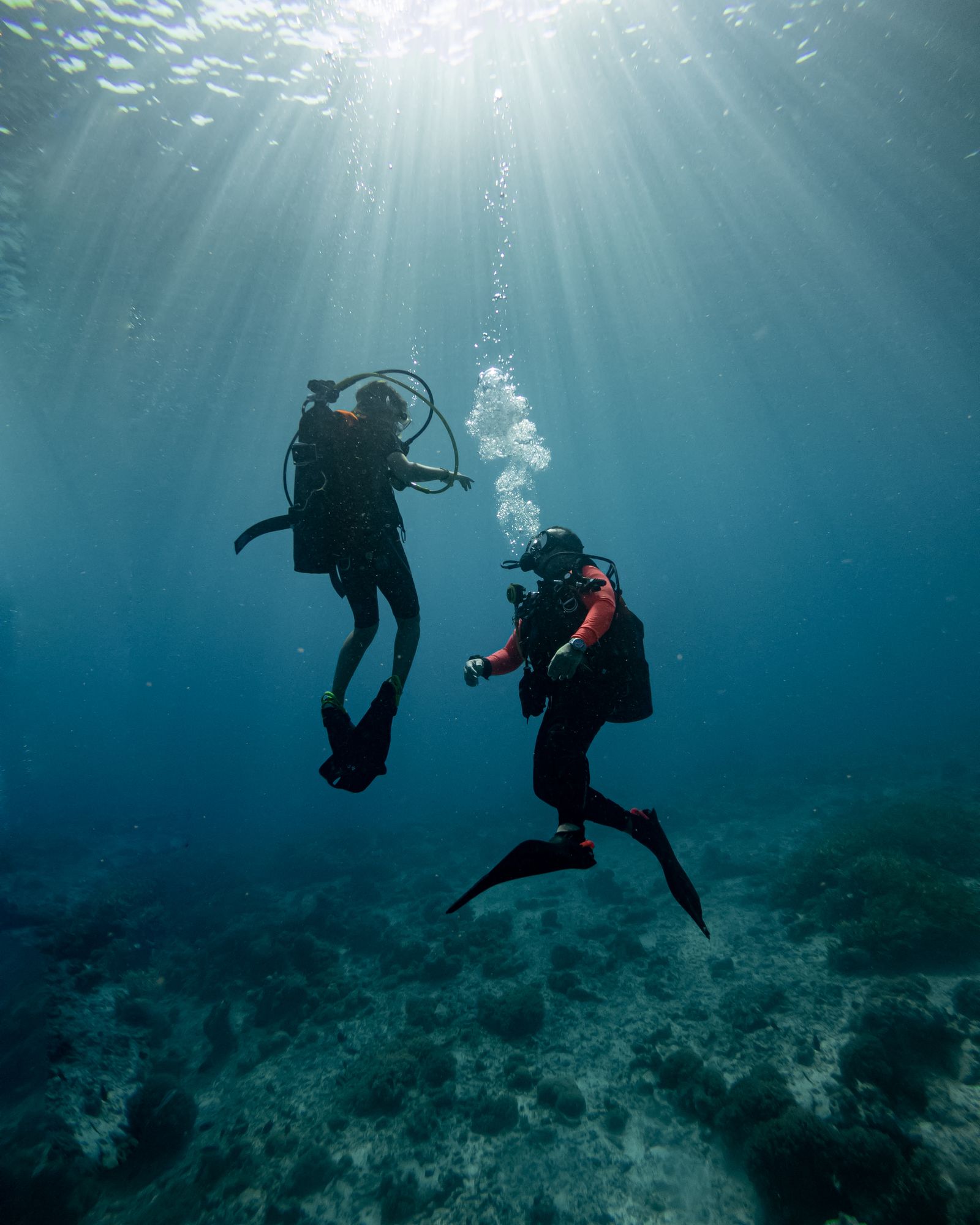
Blue water is not one colour painted onto the sea. It is the result of light travelling, being absorbed, scattered and reflected through a moving world. Once you understand the basics, the changes you see between a tropical reef, a lake and a stormy coast stop being mysterious and become part of the dive briefing.
Blue is the colour that travels
Sunlight looks white because it contains many colours. Water absorbs the longer red, orange and yellow wavelengths first, leaving more blue light to travel through it. That is why a clear tropical descent often becomes bluer with depth even before a diver has reached the reef.
It is not a paint job and it is not a promise of visibility. Blue is simply the colour that remains most available to your eyes after water has done its quiet filtering.
Depth changes the palette fast
At shallow depth, a red fin or coral can still look fairly honest. A little deeper, the same red becomes brown or grey because the red light is no longer reaching it. A torch returns those missing colours locally, which is why a night dive can make a familiar reef look like it has changed its wardrobe.
This is also why an unedited underwater photograph can feel surprising on land. Your brain was adapting underwater; the camera was only recording the light it received.
Clear water is not always blue
Very clear water often looks blue because there are few particles interrupting the path of light. But visibility and colour are cousins, not twins. A bright blue offshore site can have plankton, haze or current, while a green lake can offer excellent visibility on a calm day.
Ask about the actual conditions rather than judging a destination by its brochure. The sea has no obligation to match a colour grade.
Particles turn the water green
Plankton, sediment and tiny organic particles scatter light differently, so coastal water and lakes often read green. That is not automatically a problem. Green water can be full of life, and a slightly milky dive can be far more interesting than a blue-water swim with nothing nearby.
The practical difference is range. In particle-rich water, stay closer to your buddy, keep a reliable reference and expect the scene to reveal itself gradually rather than all at once.
The bottom joins the conversation
White sand reflects light and can make a lagoon feel bright and turquoise. Dark rock, seagrass or a deep wall absorbs more light, creating a richer blue or green. The same sea can therefore look completely different across one bay.
This matters for navigation and photography, but it also changes the mood. A pale sandy shallows invites a wide view; a dark wall asks you to slow down and see what is close.
Weather edits the view
Cloud cover, wind and surface chop change how much light enters the water. Morning sun can make a site glow; an afternoon squall can flatten the colours without making the dive poor. Surface conditions also stir sediment, especially near shore, so the prettiest postcard day is not always the clearest dive day.
A guide who adjusts the plan for light, wind or tide is reading the whole system. That is useful local knowledge, not an unnecessary detour from the original schedule.
Use colour as a briefing clue
When the water looks unusually dark, green or hazy, ask what that means for the entry, current and buddy spacing. Check your light, agree on a turnaround pressure and make sure nobody is relying on a distant landmark that may disappear after ten metres.
The colour does not tell the whole story, but it starts a practical conversation. Good diving is often less about finding perfect conditions than adapting well to the real ones.
The blue you remember
Most divers remember a particular blue: the first clear descent after travel, the blue beyond a wreck rail or the blue above a reef at the end of a slow ascent. Science explains it, but it does not flatten it.
Notice the light on your next dive. It is one of the few parts of the ocean that is always changing before your eyes, and it costs nothing extra to look.
What your mask is telling you
Your eyes lose contrast as the light and colour change, so do not confuse a distant shape with a clear observation. In blue water, a horizon may feel endless while the useful detail is close; in green water, a light can pick out a buddy long before a hand signal is visible.
That is why simple habits matter: look back often, keep the group compact and avoid letting a beautiful view pull you beyond the plan. Colour can make a site feel open or enclosed, but the dive still has the same responsibilities.
Photography needs a different plan
A wide blue scene usually needs the camera close to a subject, with the sun or water column used deliberately. Shooting from too far away leaves the particles between camera and reef to do most of the storytelling.
For colour close-ups, use a light carefully and check that it does not wash out the foreground. The most useful underwater photography lesson is also a diving lesson: move slowly, get close only when appropriate and know what you want to show before you press the shutter.
Let the conditions set the ambition
On a day of dark water and short visibility, choose a profile that rewards being close to the reef rather than searching for a grand wide-angle view. On a clear blue day, do not let the visibility tempt the group into longer, deeper or less disciplined diving than planned.
The ocean changes its visual language constantly. Learning to read it adds confidence without creating the dangerous illusion that a diver can control it.